




NSF STEM K-12 funds research and development that improves STEM teaching and learning in K-12 classrooms and informal settings, with a strong interest in AI and other emerging technologies. Proposals are accepted any time. Most research projects run $350,000 to $750,000 over two to three years, and they are usually led by a university or nonprofit working side by side with schools.
What NSF STEM K-12 pays for
The program sits in NSF's Division of Research on Learning in Formal and Informal Settings. It funds fundamental, applied and translational research on how students learn science, technology, engineering and math, and on new teaching approaches, materials and tools tested with real students. NSF asks for proposals on how AI and other emerging technologies can be used to study and improve STEM teaching and learning.
- Research and development projects: $350,000 to $750,000, usually over two to three years.
- Conferences: $25,000 to $99,000, for up to two years.
- CAREER awards ($500,000 to $750,000) for early-career faculty go through NSF's separate CAREER solicitation and its annual deadline.
Proposals far outside these ranges may be returned without review.
What happened to CSforAll, DRK-12 and ITEST?
In 2025 NSF archived Computer Science for All (CSforAll: Research and RPPs), Discovery Research PreK-12 (DRK-12), Advancing Informal STEM Learning (AISL) and Translation and Diffusion, and encouraged those applicants to consider NSF STEM K-12. ITEST (Innovative Technology Experiences for Students and Teachers) is listed as waiting for a new solicitation, with no upcoming due dates. If your team was planning a CSforAll or ITEST proposal, NSF STEM K-12 is the K-12 program open now.
Who can apply, and how schools take part
Eligible lead organizations are accredited two- and four-year colleges and universities, U.S. nonprofits such as museums and research organizations, U.S. businesses, state and local governments, and federally recognized tribal nations. There's no limit on the number of proposals per organization or investigator.
Most K-12 projects are led by a university or nonprofit, with schools and districts as partners: teachers co-design and test lessons, and students take part in the study. If your district wants to lead a proposal, ask NSF's program team at STEMK12@nsf.gov before you start.
How to apply
- Submit a full proposal any time. No letter of intent or preliminary proposal is required.
- The Project Summary must list five keywords, which can include specific STEM content such as AI.
- Follow the solicitation (NSF 25-545) and NSF's proposal guide, and talk with a program officer early about fit.
- Build in time: a research proposal needs a partnership, a study design and an evaluation plan, so start with your university or nonprofit partner months ahead.
Where Forward Education fits
Research classrooms need hardware and lessons that work on day one, so the study can focus on learning instead of setup.
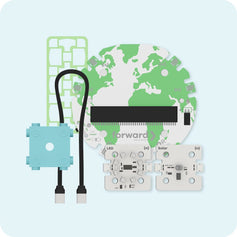
- The Coding for Good Kit gives grades 3-12 hands-on coding and robotics with 11 plug-and-play sensors and modules, 4 servos and a water pump. Every lesson includes timing, standards, an assessment and Use, Modify and Create paths.
- MicroChat is an AI coding assistant for micro:bit. The AI writes the first version of the code, then guides students through PRIMM (Predict, Run, Investigate, Modify, Make), so students plan, explain and test. That gives a research team a ready-made setting to study how students learn to code alongside AI.
- Budget example: ten classroom sets (150 Coding for Good Kits and 150 micro:bit V2 Go Packs, enough for 300 students working in pairs) come to $44,548.50 before shipping.
- Teacher training: free self-paced courses come with the kits, and live virtual PD starts at $1,000 for a 90-minute session.
Frequently asked questions
How much does NSF STEM K-12 award?
Research and development projects usually run $350,000 to $750,000 over two to three years. Conference proposals run $25,000 to $99,000. NSF expects about 40 awards and $30 million in total, depending on available funds.
Is there a deadline?
No. Full proposals are accepted any time.
Can a school district apply?
Eligible applicants include state and local governments, along with universities, nonprofits, businesses and tribal nations. Most K-12 projects are led by a university or nonprofit with districts as partners. Ask STEMK12@nsf.gov if your district wants to lead.
Is CSforAll still open?
No. NSF archived CSforAll: Research and RPPs in 2025 and encouraged applicants to consider NSF STEM K-12.
Can the grant pay for classroom kits?
NSF funds research and development, not equipment on its own. Materials can be part of the budget when the study needs them, such as kits for the classrooms taking part.
How can Forward Education help?
We can provide a letter of support, an official quote, product specifications for your budget justification and lesson details for your study design. Contact our grant team.
Source: National Science Foundation, NSF STEM K-12 program page and solicitation NSF 25-545 (page updated October 7, 2026), and the ITEST program page, checked November 1, 2026.


